
<< back to leadership articles
Organisations that employ people to do the things they are most passionate about and inspire them the most, plot a course to greatness. A person’s energy and drive is greatest in the areas they consider most important. This makes employees’ highest values organizations’ greatest strengths.
If an individual’s personal values totally conflict with their organization’s values or those of their supervisor, they are likely to ignore or reluctantly follow organizational values. But, if their values are more or less the same, they experience greater job satisfaction, are more committed to the organisation and perceive leaders as credible.
Everyone is a leader in the areas that are highest on their values hierarchy and a follower in the areas that are lowest on their hierarchy, says management consultant Mark Kahn.
Although everyone lives a unique set of values every moment of every day, an individual’s highest values stem from perceived areas of deficit, struggle and pain. “This is why great leadership emerges in times of war, when immense adversity catalyses a very powerful desire to survive. The leader who can articulate a simple and clear message of a better future has great power in challenging circumstances.”
Kahn says leaders who know their values hierarchies intimately and use them to frame their leadership visions, become great leaders. These represent the real hierarchies of values that determine their businesses’ destinies.
According to Benedictine University’s Centre for Values-driven Leadership (http://www.cvdl.org/) values-driven leaders lead from a deep sense of purpose and a demonstrated commitment to life-affirming values, such as honesty, integrity, excellence, courage, humility, trust, care for people and social and environmental responsibility.
Values-driven leadership implies a conscious commitment by leaders at all levels to lead with their values and create a corporate culture that optimizes financial performance, ethical practice, social contribution and environmental impact.
Values-driven leaders lead high performance organisations with visions that reach beyond the bottom line. They focus on possibilities and finding creative solutions to global challenges. Values-driven leadership offers a platform for leaders to unleash this potential by serving as a catalyst for personal development and transformation and by encouraging employees to engage their values, sense of purpose and intrinsic motivation to be part of something that contributes positively to society.
“This is not an ethical guideline that stifles the company’s growth, but rather a business opportunity that ignites innovation and increases performance, growth and profitability,” says the Centre.
The nine roles of values-driven leaders
Professor of Organisation and Management at San Jose State University and the author of From Sage To Artisan: the Nine Roles of the Value-Driven Leader Stuart Wells’ model offers managers a unique way to understand their strengths and how to improve their weak points.
Each of the nine values-driven leadership roles uniquely combines a significant leadership process and a critical management focus:
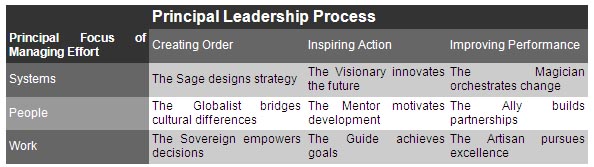
Wells outlines the characteristics of each of the nine roles:
THE SAGE
Leaders in the sage role:
- Gain wisdom by expanding their knowledge on a wide range of subjects;
- See order and patterns where others see chaos;
- Design strategy by being cognizant of the past, present and possible futures;
- Sustain curiosity and ongoing learning;
- Remain open to new ideas and ways of thinking; and
- Understand complex, ambiguous situations and find the best path forward for their organisations.
THE VISIONARY
Leaders in the visionary role:
- Dream seemingly impossible dreams and turn them into real possibilities;
- Innovate powerful ideas about the future;
- Articulate those ideas in simple terms to inspire whole organisations into action;
- Sustain creativity and optimism; and
- Are committed, determined and undeterred by obstacles in the path of the vision.
THE MAGICIAN
Leaders in the magician role:
- Make things change form without wasting effort;
- Orchestrate change by keeping a balance among the structures, systems and processes, as the old state dissolves and the new state forms;
- Have the ability to let go of the present without a guarantee of the future; and
- Sustain calmness, despite the transition's turbulence.
THE GLOBALIST
Leaders in the globalist role:
- Become world travelers in body, mind and spirit; Foster their organizations’ success by leveraging the diversity of their workforces and furthering their global activities;
- Bridge cultural differences by demonstrating interest, understanding and appreciation of different cultures;
- Find common ground where people can work productively; and
- Are willing to question their own beliefs and remain open to ideas offered by people from different backgrounds.
THE MENTOR
Leaders in the mentor role:
- Are committed to ongoing personal and professional development;
- Help people advance their careers through various learning opportunities;
- Honor the development desires of each person;
- Are devoted to the uniqueness of each individual; and
- Motivate others by creating environments where people find their own inner drive.
THE ALLY
Leaders in the ally role:
- Build partnerships by seeking ever higher standards of effective, mutually beneficial collaboration;
- See the benefits of productive work partnerships in teams, informal interactions, and work with suppliers, customers and other stakeholders;
- Realize conflict is often a sign of opposing valuable perspectives, and seek dialogue to extract benefit from it; and
- Generously extend their trust to others.
THE SOVEREIGN
Leaders in the sovereign role:
- Always use their power thoughtfully;
- Take risks and face uncertainty decisively;
- Accept responsibility for the consequences of their decisions;
- Take a stand, even if it is unpopular;
- Empower others by extending decision-making authority to them; and
- Remain completely reliable when it comes to honoring their commitments.
THE GUIDE
Leaders in the guide role:
- Are flexible organizers who keep people and things in directed motion;
- Achieve goals by applying clearly stated principles that are based on core values and guide actionable tasks;
- Make the journey as worthwhile as the goals;
- Are excited to keep things moving forward, regardless of the obstacles and restraints; and
- Use their expertise to do the work and support others’ efforts.
THE ARTISAN
Leaders in the artisan role:
- Devote their efforts to the mastery of their crafts;
- Pursue excellence by continually questioning the quality standards of the products and processes used to create them;
- Balance aesthetic and practical standards;
- Pay attention to detail to find ways to ensure product simplicity, effectiveness and efficiency;
- Are intolerant of indifference; and
- Push the limits of everyone's expertise.
Wells says ways organisations use these roles include:
- Leadership development
Many organisations organize their ongoing and future leadership development opportunities, including online help, informal learning groups and workshops, to support skills related to the roles.
- Team building
Interpersonal work and communication problems, which often seem mired in personality clashes, drain organisations of energy. An appreciation of the nine leadership roles lets people see others’ contributions to the organisation from different perspectives and help teams work more effectively.
- Organisational development
The nine roles represent an organization's intellectual capital. The framework is used to analyze an organization's strategy and future direction by determining the role strengths that are necessary for its success. The model is also tied into the organization's job description and placement, and career development processes and systems.