
<< back to talent optimization and culture articles
By Christine Leonardi
Organisations that maximize employee passion – a key factor in creating customer loyalty grow more sustainably, make more money and perform better on the stock market than their apathetic peers.
According to researchers at leading training and development firm The Ken Blanchard Companies®. Dr Drea Zigarmi, Dobie Houson and David Witt, employee passion extends beyond the meaning of some of the present research on engagement. It is a complex end state, dependent on eight critical success factors:
- Meaningful work
- Collaboration
- Fairness
- Autonomy
- Recognition
- Growth
- Connectedness with leaders
- Connectedness with colleagues
“All eight factors must be present to influence an individual’s commitment to the organisation, their commitment and passion about their current job, their intent to stay with the organisation, and their intent to recommend the organisation to others,” Zigarmi, Houson and Witt say.
They found that the concept of meaningful work is most closely linked to an individual’s commitment, enthusiasm, and passion for the job and the organisation, and the desire to work overtime.
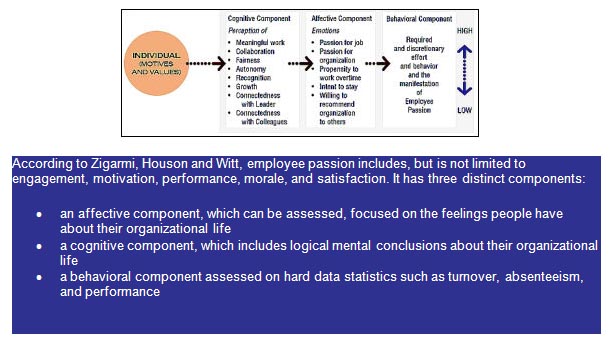
Zigarmi, Houson and Witt outline the eight factors influencing employee passion, as follows:
Meaningful work
Meaningful work relates to an organisation where people feel that their work is worthwhile and is connected to both the organisation and a larger purpose.
When doing Meaningful Work, individuals understand how their work adds value and believe that their organisation helps its customers through its products and services.
Ultimately, employees need to understand where they are going in relation to the vision, to buy into the culture, to know what the company stands for, and to understand how to connect their work to the strategic imperatives.
Collaboration
Collaboration
hinges on creating an environment that is motivating and inspiring and where
people work together to help one another succeed.
A key trait of high performing organisations is shared power and high involvement where participation, collaboration, and teamwork are the way of life.
A corporate culture that encourages sharing and team spirit is essential to creating collaboration.
In addition, it is important for colleagues and leaders to support one another on tasks and to express appreciation for one another’s ideas.
Fairness
The top reason for leaving an organisation is when employees perceive that
justness and fairness are not present in the organisation.
The concept of Fairness as reviewed in the literature can encompass many things including an environment where pay, benefits, and workload are fair and balanced and equitable and in which people treat each other with respect and leaders act in an ethical manner.
While we recognize that the concept of Fairness includes distributive, procedural, and interactive components, our study focused primarily on the distribute component.
Employees need to perceive that leadership, and the organisation as a whole, treat them and customers fairly and justly.
Autonomy
Autonomy provides individuals with the tools, training, support, and the
authority to make decisions.
It involves creating an environment where management style is collaborative and participative, allowing people to feel empowered to make decisions about their work and tasks, in control of their work, and in their ability to achieve their goals.
People need to have input and influence over how their tasks are performed and they need to feel that they have the ability and information necessary to make decisions about their work.
Additionally, clear guidelines must be in place to allow individuals to succeed in regard to making decisions about their tasks.
Recognition
Most people appreciate being praised and appreciated, or otherwise recognized
for their achievements.
Most individuals value being recognized for their accomplishments by team members and their leader.
Individuals also value monetary recognition as well as verbal and written recognition. They can find intrinsic recognition in the fact that they are doing work that improves relationships with people.
Growth
Having opportunities to learn and grow professionally and develop skills that
lead to advancement in one’s career are core to the concept of growth.
Having a manager and organizational systems that provide these opportunities, as well as being in an environment or department where colleagues can learn from one another or coach each other are important dimensions that support individual growth.
In addition, individuals need to feel that they are part of the process in terms of career planning.
The items most strongly correlated with the concept of growth, include:
- Having a manager who assists with future career planning
- The ability to learn from co-workers to enhance one’s current job
- Opportunities to grow and improve
- The ability to influence one’s own career path.
- Connectedness with the leader
- Having a solid relationship with one’s leader and colleagues that is based on integrity and trust is a key component in creating employee passion.
Connectedness with leaders
Having a solid relationship with one’s leader and colleagues that is based on integrity and trust is a key component in creating employee passion.
People need leaders who share information and make an effort to build rapport. A leader who takes an interest in his or her employees and shares personal information is more likely to establish and maintain connectedness with direct reports than one who does not.
Connectedness with colleagues
Just as a solid relationship with one’s leader impacts employee passion, so too does a strong relationship with colleagues and co-workers.
People want to have a personal connection with their co-workers in addition to a professional work relationship.
There is a human need to connect. People want to care about others, and they want others to care about them.